RIBA appoints new Chief Executive

Royal Institute of British Architects Press Release 

For immediate release: 19 September 2016

Royal Institute of British Architects (RIBA) appoints new Chief Executive

new-riba-chief-executive-alan-vallance

Alan Vallance has been appointed Chief Executive of the Royal Institute of British Architects (RIBA) following a competitive recruitment process.

Alan Vallance has a background in finance, consulting, strategic planning and general management in Europe and Australasia. He joined the RIBA in September 2015 as Interim Director of Finance and Operations and has been interim Chief Executive since February 2016.  Prior to joining the RIBA Alan spent three years as Chief Operating Officer at the Law Society, the membership and regulatory body for solicitors in England and Wales.

RIBA President Jane Duncan said:

“I am delighted that Alan Vallance has been appointed as Chief Executive of the RIBA. We had a large and strong field of applicants and the interview panel were unanimous in concluding that Alan is the right person to lead the RIBA as we deliver our 5 year strategy.  As Interim Chief Executive since February this year, Alan has demonstrated his energy, drive and commitment to strengthening the RIBA’s voice and impact as a global professional membership body driving excellence in architecture.’

Alan Vallance said:

“Architects are creative, visionary and collaborative professionals who ensure that our built environment serves and strengthens communities now and in the future. It is a privilege to have been appointed to the role of Chief Executive of the RIBA. I look forward to working with the Board and Council, the staff team and members in the UK and globally to deliver the RIBA’s five year strategic plan and to further strengthen the RIBA’s offer to current and future members.”

ENDS 

Notes:

  1. For further press information contact Howard Crosskey in the RIBA Press Office crosskey@riba.org 020 7307 3726
  2. An image of Alan Vallance can be downloaded here: https://riba.box.com/s/dyb8xesdwguh5ln19c0e7l4um3r6jdyw
  3. Alan tweets at @Alan_Vallance
  4. Alan Vallance trained as a chartered accountant and has a background in finance, consulting, strategic planning and general management across a wide variety of roles in Europe and Australasia. Prior to joining RIBA in September 2015 as Interim Director of Finance & Operations, Alan spent three years as Chief Operating Officer at the Law Society, the membership and regulatory body for solicitors in England and Wales. Between 2009 and 2011 Alan was the Chief Operating Officer of the Australian Bureau of Meteorology, the national weather agency, based in Melbourne, Australia. As part of his responsibilities, Alan spent considerable time at the United Nations in Geneva participating and leading Australian Delegations at the World Meteorological Organisation. Alan is a Fellow of the Institute of Chartered Accountants in England and Wales, the Institute of Chartered Accountants in Australia and New Zealand and the Australian Institute of Company Directors. He obtained a BA (Hons) in Economics at the University of York.
  5. The Royal Institute of British Architects (RIBA) is a global professional membership body that serves its members and society in order to deliver better buildings and places, stronger communities and a sustainable environment. architecture.com Follow us on Twitter for regular RIBA updates www.twitter.com/RIBA

Tour of Three Private Houses in Suffolk on 26 October 2016

American Friends and Patrons are invited to join a full day on Wednesday 26th October 2016 as we explore the Suffolk countryside and three private houses that respond to their surrounds in remarkably different ways.

Walk Barn Farm

Sitting in a wide open pasture surrounded by Suffolk heathland, Walk Barn Farm has been compared to a Frank Lloyd Wright prairie house. Three wings project out in to the landscape with a raised terrace and decked areas nestled between them. Black timber cladding, galvanised steel Crittal windows and polished concrete floors are all materials in keeping with agricultural buildings, but are here employed with a sensitivity that is unmistakably domestic. Designed by Charles Barclay Architects, Walk Barn Farm was awarded a 2013 RIBA Regional Award.

Heveningham Hall

Heveningham Hall is one of the grandest Georgian country homes. Designed and built by Sir Robert Taylor in 1778 around an earlier building of 1714, it was completed a couple of years’ later by James Wyatt, who also designed the interiors. The grounds of just over 200 hectares include landscaping by Capability Brown and further significant buildings such as the Orangery, Temple and icehouse. The present owners have undertaken an extensive programme of restoration. They invite us for lunch and a rare glimpse inside the Hall.

Marsh Hill

Marsh Hill was designed by the RIBA Award-winning practice Mole Architects. Described by Elle Decoration as making buildings that are ‘not just green but gorgeous’, Marsh Hill exemplifies their commitment to cutting-edge sustainability and distinctive design. A twisting zinc roof folds up to contain the master bedroom and a linear plan makes the most of stupendous views over the tidal salt marshes and the River Alde. The owners and the architect invite us to hear how this remarkable home came to be.

As for logistics, we will depart promptly at 7.30am by private coach from RIBA, 76 Portland Place, London W1B 1NT and will return around 7.30pm. The journey takes a little over three hours each way.

There will be a cost of £50 per person to cover transportation and refreshments.

For more information and to book your place, please contact the Development Office on 0207 307 3809 or Patrons@riba.org.

Autumn Installation Launch with artist Giles Round on 21 September 2016

On Wednesday 21st September, American Friends and Patrons are invited to the opening of RIBA’s autumn installation in our London HQ. ‘We Live in the Office’ is a site-specific commission by Giles Round drawing on RIBA’s collections and exploring the tension between the changing interior and static exterior of buildings. We will be turning RIBA inside out with talks, films, workshops and activities working between graphics, design, art, architecture, interiors, and set design.

Please note that Benefactors and Founders will also be invited to an intimate dinner to celebrate RIBA’s artistic and architectural collaborations.

Please click here for more information.

RIBA13380
Artist Giles Round found inspiration in the RIBA Collections including Berthold Lubetkin’s drawing of an Unexecuted alternative design for a prefabricated house front, 100 Houses Scheme, Thorntree Gill Housing, Peterlee from 1944. © RIBA Collections


The Magnetic North, a Special Live Performance, on 9 August 2016

The Magnetic North presents The Prospect Of Skelmersdale a special live performance at RIBA on Tuesday 9th August 2016.

American Friends are welcome to join us for a one off special event with The Magnetic North performing with a full band line up (including strings and woodwind) and the premier screening of their new short film, with appearances from very special guests from the architecture and literary world.

The band’s new album The Prospect Of Skelmersdale explores themes of utopian dreams, architecture, new towns, people and place. In partnership with the RIBA and co-curated with @vine_collective/Third Nature the event will complement the themes of the current exhibition At Home in Britain – Designing the House of Tomorrow.

Please click here for more information and tickets.

Magnetic North Gig 9 August 2016
The Magnetic North (Image credit: McCoy Wynne)

RIBA presents ‘Constructing Communities’ as part of LFA

Constructing Communities’ Open Call as part of the London Festival of Architecture

This summer the RIBA presents works from our ‘Constructing Communities’ Open Call as part of the London Festival of Architecture, at Peckham Levels and at 66 Portland Place. At our headquarters, we are presenting three ambitious 1:1 installations.

The RIBA’s Constructing Communities open call set out to find works by large to small practices and students, responding to ideas of how architecture can influence or create communities. The works selected from the open call are exhibited in two sites across London over the summer, in Peckham and at our headquarters at 66 Portland Place.  Members of our Small Practice Group, Rachael Davidson (HÛT Architecture) and Chris Bryant (alma-nac), developed the exhibition design across both sites.

Three of the open call submissions have been developed and built as one-to-one installations throughout the RIBA building, with each team awarded £5,000 to realise their structures on a true scale. We are delighted to show projects that have found new ways for architecture to ‘construct communities’ through information exchange, empathy, and recycling. The three selected teams are made up of a group from Feilden Clegg Bradley Studios, Erect Architecture, and MARGIN, a collective of former students from Liverpool.

The exhibition at the RIBA launched with our Late Tuesday on 21 June with a series of talks, debates, forums, and was virtual reality presented by our sponsors, Cityscape Digital. The exhibition will be open each day from 10am to 5pm, until 4 August.

The exhibition of sixteen longlisted projects takes place at Peckham Levels, a creative hub hosting a series of cultural events over the summer.  For further details of the exhibition at Peckham Levels, please click here.

In partnership with London Festival of Architecture.

American Friends are invited to visit our headquarters and engage with these works.

constructing-communities-riba-london-festival-of-architecture-2016
RIBA is displaying three pavilions for its Constructing Communities exhibition, including Pea Soup House by Feilden Clegg Bradley Studio. The concept is a servery to raise awareness of air quality in London by serving a soup relating to each air quality rating. The name references the industrial revolution when London’s air was described “as thick as pea soup” and Londoners were referred to as Pea Soupers. “With air quality increasingly deteriorating in cities, we believe that architecture has a significant role in protecting the health of urban communities and improving quality of life for those at home in Britain,” said project architect Charlotte Knight. Photo credit: Dezeen

Captivating Copenhagen – Trip review

This May saw Copenhagen as the location for the first ever international trip for RIBA Patrons and American Friends of the British Architectural Library.

Following a warm welcome at the British Ambassador’s newly renovated residency, the group saw and experienced the city’s architectural (and culinary!) highlights.  The group had personal tours of contemporary award-winning buildings, with their architects, such as Schmidt Hammer Lassen’s Black Diamond extension of the Royal Danish Library; Henning Larsen’s beautiful intervention in the Ny Carlsberg Glyptotek; BIG’s ski slope atop a waste to energy plant and later a wonderful dinner in the Maritime Museum, Helsingor; and 3xN’s Bella Sky and Aquarium visit – not least the breath-taking roof-top tour. They also experienced the forerunners of great Danish design visiting Arne Jacobsens’s Bellevue and more with his grandson Tobias; as well as Finn Juhl’s house neighbouring the Zaha Hadid extension at Ordrupgaarde and later Soren Varming’s stunning mid-century jewel.

A huge thanks to all our Danish hosts for making the trip so special.

Plans are afoot for the next international trip.  Please get in touch if you are interested in hearing more.

Copengahen Trip Pictures
Outtakes from RIBA visit to Copenhagen May 2016

RIBA National Awards Party on 13 July 2016

RIBA with Arper UK is delighted to invite all American Friends to a celebratory event for all 2016 RIBA National Award winners on Wednesday 13 July at the Serpentine Galleries Pavilion, designed by Bjarke Ingels Group (BIG). BIG’s vision is an ‘unzipped wall’ that is transformed from straight line to three-dimensional space, creating a dramatic structure that by day houses a café and free family activities and by night becomes a space for the Serpentine’s acclaimed Park Nights programme of performative works by artists, writers and musicians.

This year, and in tandem with the 16th Pavilion in 2016, the Serpentine Galleries has expanded its internationally acclaimed programme of exhibiting architecture in a built form by commissioning four architects to each design a 25sqm Summer House. The four Summer Houses are inspired by the nearby Queen Caroline’s Temple, a classical style summer house, built in 1734 and a stone’s throw from the Serpentine Gallery. In line with the criteria for the selection of the Pavilion architect, each architect chosen by the Serpentine has yet to build a permanent building in England.

The Serpentine Pavilion, designed by Bjarke Ingels Group (BIG), is an ‘unzipped wall’ that is transformed from straight line to three-dimensional space, creating a dramatic structure that by day houses a café and free family activities and by night becomes a space for the Serpentine’s acclaimed Park Nights programme of performative works by artists, writers and musicians. The four Summer Houses include Kunlé Adeyemi’s Summer House which is an inverse replica of Queen Caroline’s Temple – a tribute to its robust form, space and material, recomposed into a new sculptural object. Barkow Leibinger were inspired by another, now extinct, 18th Century pavilion also designed by William Kent, which rotated and offered 360 degree views of the Park. Yona Friedman’s Summer House takes the form of a modular structure that can be assembled and disassembled in different formations and builds upon the architect’s pioneering project La Ville Spatiale (Spatial City) begun in the late 1950s. Asif Khan’s design is inspired by the fact that Queen Caroline’s Temple was positioned in a way that would allow it to catch the sunlight from The Serpentine lake.

There will be a Champagne Taittinger reception and speeches from RIBA President, Jane Duncan, RIBA Awards Group Chair, Philip Gumuchdjian and BIG Senior Project Manager, Ziad Shehab.

If you are able to attend, please do RSVP to Patrons@RIBA.org.

RIBA National Award Winners Party invitation_2016_FINAL

Patrons Summer Party on 22 June 2016

We would like to invite all American Friends to join us on Wednesday 22nd June for the Patrons Summer Party 2016. This year, we are congregating at the National Theatre for a tour of the recent renovations with Stirling-prize winning architects Haworth Tompkins and a talk on the notable holding of the Lasdun Archive in the RIBA Collections given by distinguished Denys Lasdun specialist, Dr Barnabas Calder. Sir John Tusa will be hosting this event which promises to be wonderful evening of theatre and architecture in the seminal, post-war modernist building that is the National Theatre.

For more on Denys Lasdun, please click here for this inspirational architect’s fact sheet.

Front of RIBA Patrons Summer Party Invitation 2016

Return from The Grand(er) Tour

We have just returned from a marvellous trip accompanying Abraham Thomas’s lecture tour, The Grand(er) Tour: Architectural Imagination Beyond the Classical World, with the Royal Oak Foundation. It was wonderful to meet old friends and new in New York, Philadelphia, Washington DC, Boston and Chicago. Each city was very welcoming and we were spoiled with the weather – and look forward to coming back soon!

A huge thanks to the ladies of the Royal Oak Foundation for organizing an incredible tour and to Abraham for his fascinating lectures on the influence on architecture from places outside the Greco-Roman sites and sights of the traditional Grand Tour. For centuries, architects have used travels to fuel their cultural and artistic education but starting in the 19th century architects often travelled further afield, venturing to regions such as Southern Spain, the Middle East, Japan, China and India, seeking inspirational sources from Ancient Egypt or the Islamic world. Abraham spoke fluently of architecture by the likes of Owen Jones, Edwin Lutyens, Charles Voysey, William Burges and Louis Khan and the influence that their Grand(er) Tours had on their oeuvre.

Please see below for a few highlights from this wonderful trip…

On Tour with The Grand(er) Tour - Architectural Imagination Beyond the Classical World - Final

Inaugural International Trip: Destination Copenhagen! 18 to 21 May 2016

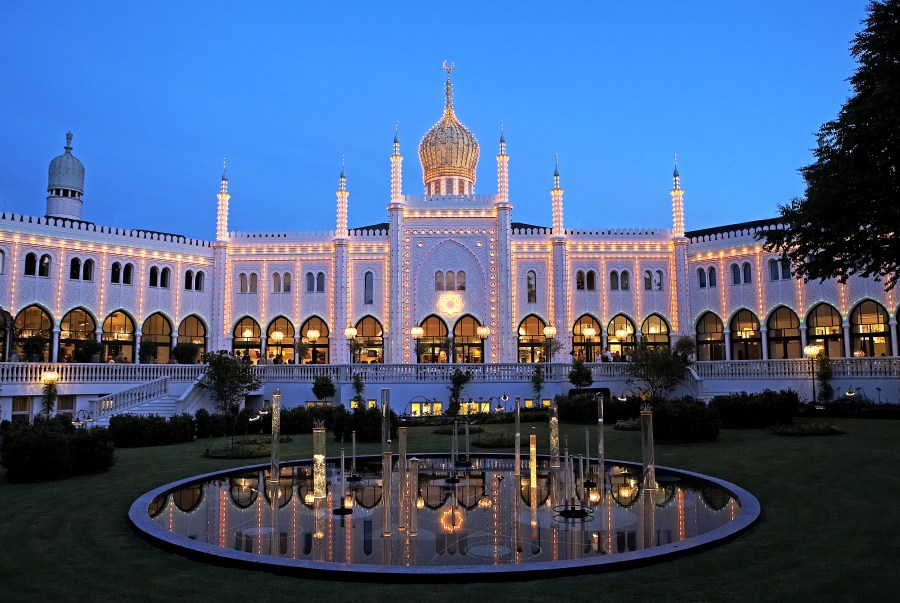
Nimb Facade from Tivoli gardens
Nimb Facade in the Tivoli Gardens in Copenhagen, Denmark

Save the dates for 18 to 21 May 2016 as we have an architectural tour exclusively arranged for Patrons of Architecture and American Patrons of the British Architectural Library to Copenhagen.

Although subject to change, the schedule is as follows:

DAY ONE
WELCOME TO COPENHAGEN!
We check into Hotel Nimb, an exquisite Moorish folly in the Tivoli pleasure gardens, now the city’s most luxurious boutique hotel. Our first day introduces us to the city with a canal tour of the historic sites. That evening, we are officially welcomed by the British Ambassador at a party in our honour, introducing us to the movers and shakers of the Danish design scene. We head for dinner at one of the city’s celebrated restaurants then back to Nimb for our first night’s sleep.

DAY TWO
MODERN CITY
On our second day, we visit two contemporary additions to historic cultural buildings with their architects: Henning Larsen’s ‘building within a building’ at the Ny Carlsberg Glyptotek and Schmidt Hammer Lassen’s Black Diamond extension to the Royal Library. We will be hosted for lunch by Danish design firm Louis Poulsen before a hard-hat tour of Bjarke Ingels Group (BIG)’s latest Copenhagen landmark: a waste-to-energy plant complete with public ski slope. That evening, we are free to explore New Nordic Cuisine or head to Henning Larsen’s waterside Opera House for an evening performance. We sleep at Nimb.

DAY THREE
ESCAPE THE CITY
We begin day three by celebrating Arne Jacobsen, arguably the most famous name in Danish design. In the company of Tobias Jacobsen, the architect’s grandson, we visit the SAS Hotel and National Bank before heading up the coast to Bellevue, Jacobsen’s beach resort a few miles north of the city. We stop at Kokkedal Castle, a country retreat of 1746, now a luxury hotel. We spend the afternoon here for lunch and to enjoy the grounds or relax in the spa. The evening begins with a tour of the Louisiana Museum of Modern Art, where the landscaped galleries overlook the narrow water to Sweden. After a sunset drink here, we travel to Helsingor for dinner at BIG’s Maritime Museum. This bold design is embedded in a former dry dock in the shadow of Hamlet’s castle. We will meet those who delivered a design and engineering miracle, helping regenerate an abandoned industrial site. We sleep nearby at Kokkedal.

DAY FOUR
DESIGNING THE FUTURE
Our final day starts with another mid-century classic: the Varming House. Jørgen Varming’s grandson Søren will show us domestic innovations that exemplify the spirit behind Steensen Varming’s mechanical engineering, not least the Sydney Opera House. Back in Copenhagen, we explore the future of Danish architecture: first at the Royal Danish Academy of Fine Arts, where the Head of Architecture will introduce us to the students as they prepare their final projects for presentation; then we visit Ørestad, a developing city district. From the Sky Bar on the 23rd floor of 3XN’s Bella Sky Hotel, we meet those shaping the new town concept and view the distinctive urban plan and architecture. From here it is a short drive to the airport or transfer back to the city for those who wish to extend their trip.

For more information and pricing, please get in touch with us on patrons@riba.org.

RIBA17696
This is a drawing by Laurids de Thurah (1706-1759) from Den Danske Vitruvius (Copenhagen, 1749), vol. 2, pl. 3 of Sorgenfri Palace in Lyngby, Denmark which was originally built in 1706 to designs by a German architect, Francois Dieussart. After this country seat became a royal palace in 1730 Thurah was engaged to build a new wing for the gentlemen of the Court and later to demolish the main building and build a new palace (1757). The building was extended and modernised in 1794. © RIBA Collections